AI is quietly becoming the most valuable asset in modern hotel management system - driving
higher revenue, lower costs and superior guest experiences 24/7.
The future of hotel management is not about working harder - it is about automating smarter!
From dynamic room pricing to instant guest support, AI-integrated hotel operations system is
redefining how properties create value in an increasingly competitive market.
The modern hotel never sleeps and neither does AI! Operating around the clock, intelligent
automation is helping hotels improve service quality, reduce costs and unlock new revenue
opportunities.
What Is AI-Powered Hotel Management Software?
AI-enabled hotel management software uses machine learning to replace manual administrative
tasks with automated workflows. By analyzing large volumes of real-time data, Artificial
Intelligence (AI) can identify patterns, predict demand and support faster, more accurate
decision-making.
This enables hotels to improve operational efficiency, deliver more personalized guest
experiences, maximize revenue and streamline day-to-day operations with minimal human
intervention.
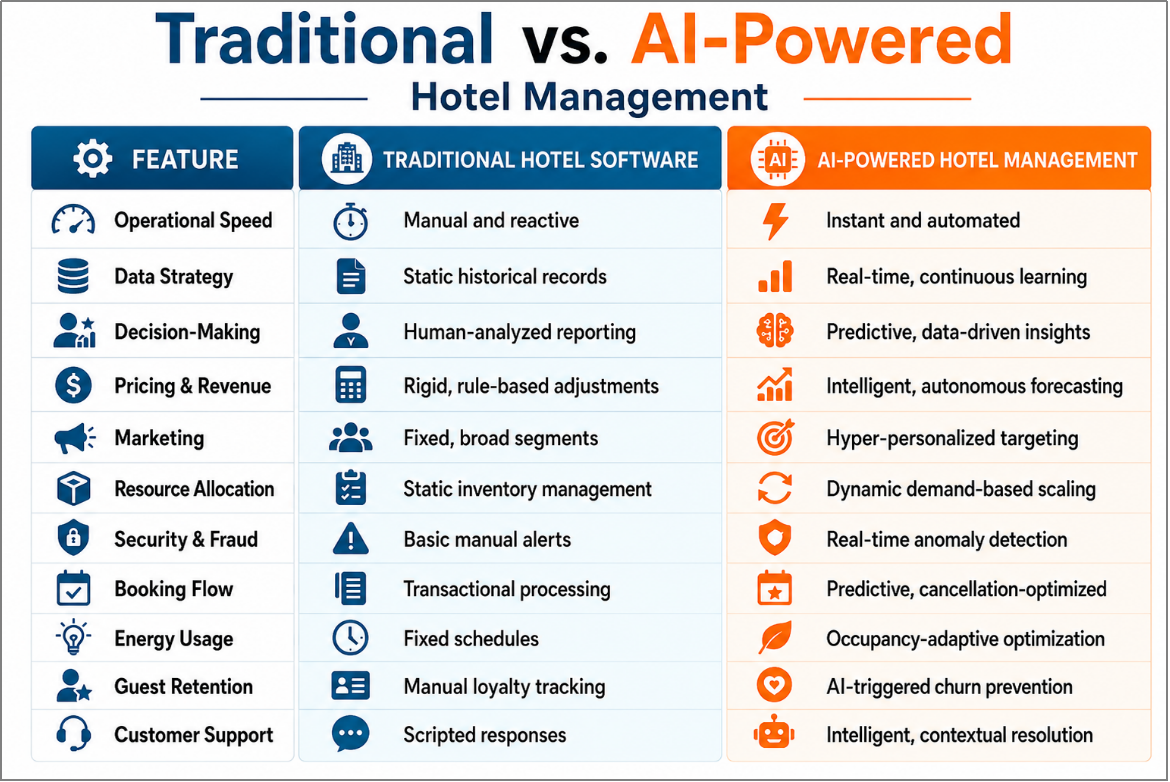
Traditional Hotel Software vs AI-Integrated Hotel Management Software
Traditional hotel software operates on rigid predefined rules and programmed workflows. It
executes tasks only when specific conditions are met.
Artificial Intelligence in hospitality industry, on the other hand, uses predictive
intelligence and automated analysis of large volumes of operational and guest data to
anticipate market changes, optimize pricing strategies, allocate resources more effectively,
automate routine tasks and enhance guest satisfaction.
In a nutshell, AI allows hotels to shift from reactive operations to proactive, data-driven
hotel management.
Figure: Traditional vs AI Hotel
Manager Comparison
How AI Technology Adoption Is Rising in the Hospitality Industry
Adoption of AI in the hospitality industry is surging, with recent studies showing over 82%
of hotels expanding their use of artificial intelligence. Around 78% of large hotel groups
are already investing in AI-driven dynamic pricing across multiple channels to maximize
booking revenue.
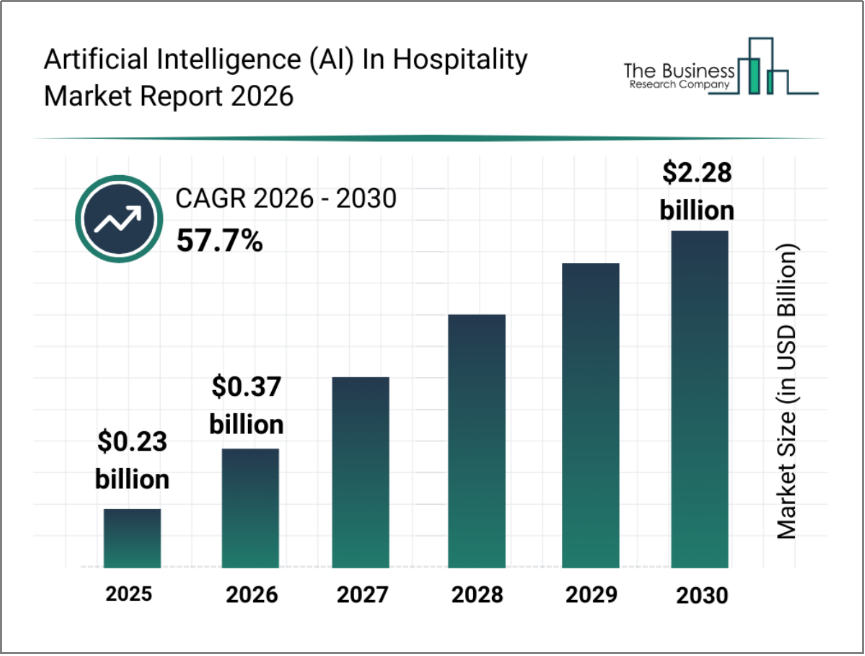
And according to Business Research Company, the use of
artificial intelligence in
hospitality industry has reached a market size of $0.23 billion in 2025. It is further
projected to grow to $2.28 billion by 2030, at a strong 57.7% CAGR.
Figure: AI in Hospitality Market
Growth 2026
These figures highlight that hospitality AI solutions are becoming central to this industry.
McKinsey & Company rightly asserts that the hotel industry is
entering an agentic AI era.
Hotels are using AI as a core RevPAR-driving system that improves pricing accuracy, boosts
occupancy and delivers direct, measurable revenue gains.
65% of travel & mobility tech investments
between 2018 and 2024 were directed toward AI and Machine
Learning,
highlighting strong investor confidence in AI-driven
transformation.
Some Applications of AI in the Hotel Industry: Use Cases & their Benefits
A normal hotel management system just connects hotel operations by unifying departments into
one system. But AI-integrated systems learn from live data to improve decisions, shifting
hotels from manual coordination to real-time intelligence.
AI-powered Dynamic Pricing
AI-powered dynamic pricing uses machine learning to analyze vast market variables in real
time and automatically optimize room rates. But similar outcomes are also achieved in
traditional Revenue Management Systems (RMS).
Well, the critical difference lies in automation, speed and data capacity. Traditional RMS
relies on human-defined pre-programmed rules and static thresholds. Prices adjust
semi-automatically based on set conditions like weekends, seasons or occupancy levels. It
reacts only when predefined triggers are met.
On the other hand, AI systems act like a digital revenue manager. They continuously learn
from live data and adapt in real time by tracking signals like room bookings, competitor
rate changes and event-driven demand spikes. Based on this, they automatically adjust prices
to maximize revenue without waiting for preset rules.
As per reports, hotels implementing AI-driven pricing
solutions have achieved 10–15% revenue
growth, highlighting how AI-powered dynamic pricing effectively captures real-time demand
fluctuations.
There are numerous benefits of AI-based dynamic pricing in hotel industry. We are outlining
only a few here:
Revenue optimization (RevPAR/Yield maximization): AI dynamically optimizes
ADR and
occupancy to maximize RevPAR using demand elasticity and willingness-to-pay (WTP)
models.
Competitive set rate positioning (STR benchmarking): It continuously
ingests comp-set pricing and occupancy signals to adjust rate parity/positioning
against market indices such as MPI (Market Penetration Index) and ARI (Average Rate
Index).
Inventory yield control: AI allocates room inventory efficiently to reduce
unsold room nights and maximize yield per available room (RevPAR/RN).
Segmented price discrimination: AI applies customer segmentation
(business, leisure, OTA, direct, corporate) with elasticity-based pricing curves to
maximize conversion.
Automation of RMS workflows: Replaces rule-based rate loading with
AI-driven decision systems that automate BAR updates, length-of-stay controls and
demand-based pricing adjustments in real time, reducing latency and manual
intervention.
dataintelo,
revealed that over 62% of mid-scale and upscale hotel brands are using at
least one automation solution in 2026.
Hyper-Personalization in Hospitality
AI-driven hyper-personalization goes beyond static guest profiles. It continuously fuses
behavioral signals, context and predictive intent to generate moment-to-moment
individualized marketing across platforms.
1. Pre-Arrival (Intent +
Expectation Shaping)
AI builds intent from browsing behavior, booking patterns and external signals to shape the
stay before the guest arrives.
Guests receive customised offers on WhatsApp like “Instagrammable beach photoshoot package”,
sunset dinners for couples or work-ready setups for business travelers, along with add-ons
like early check-in and airport transfers.
2. During Stay (Real-Time
Experience Orchestration)
This layer shifts AI from predictive to operational. The system responds to live guest
behavior inside the hotel, for instance, tracking their app usage, location movement, dining
choices and service requests.
Example: A guest
visiting the pool at sunset may receive a contextual WhatsApp
recommendation for dining options like tandoori platters, kebabs and signature drinks.
3. Post-Stay (Retention +
Memory Reinforcement)
After checkout, AI focuses on recall, loyalty and conversion. Follow-ups are not generic
“thank you” emails but memory-based narratives. Retargeting ads mirror the emotional peak of
the stay (romantic, wellness, adventure) improving repeat bookings and loyalty.
Industry analysis: Hilton Worldwide’s AI strategy
Hilton Worldwide’s AI strategy positions it as a long-term leader in
hospitality technology. Its advantage rests on its loyalty program (200M+
members) as a massive data engine, the Connected Room IoT platform capturing
real-time in-room behavioural data and a highly scalable franchise model.
Together, these form a closed-loop data flywheel where guest identity,
behaviour and preferences continuously train AI systems. As a result, they
can deliver hyper-personalized experiences. At the same time, they are
strengthening loyalty and generating more data. This AI strategy leads to
5–8% revenue gains from dynamic pricing and a 20% increase in marketing
conversion through personalization at scale.
Sentiment Analysis using AI
AI-based sentiment analysis converts unstructured guest feedback (reviews, social media,
surveys) into actionable insights. Using Natural Language Processing (NLP), it detects
emotional tone (positive, neutral, negative) and key pain points, helping hotels improve
guest satisfaction and ratings.
Core Capabilities and Benefits:
Aspect-Based Analysis: Breaks feedback into service areas like cleanliness,
staff, Wi-Fi and food quality for precise operational improvements.
Real-Time Alerts: Flags negative reviews or distressed mentions instantly,
enabling quick service recovery before checkout or escalation.
Predictive Insights: Identifies recurring sentiment patterns to detect
operational issues early, such as underperforming rooms or amenities.
Personalization: Uses sentiment history and preferences to customise guest
experiences, from upgrades to dietary accommodations.
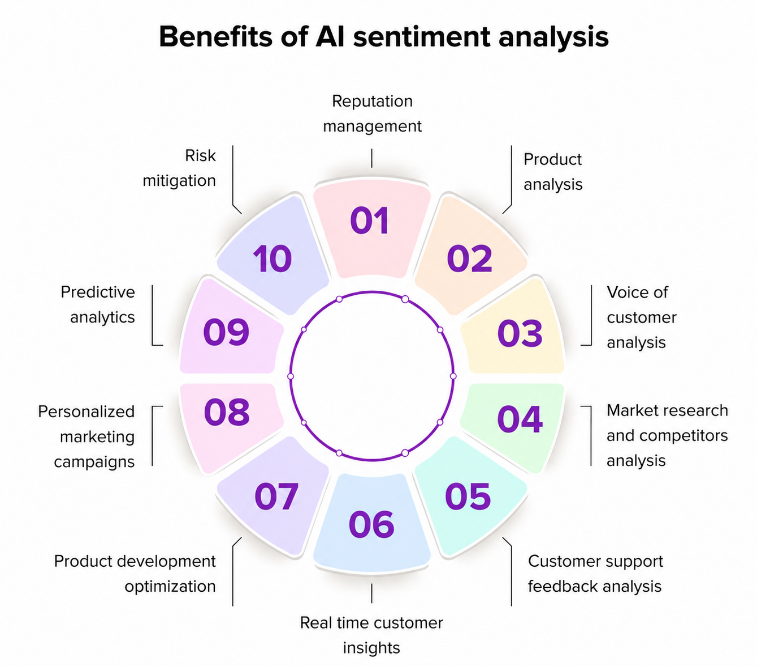
Figure: Top Benefits of AI
Sentiment Analysis for Hotel Management
AI-powered chatbots
AI-powered chatbots act as virtual concierges, automating AI communications for hotels’
guests, managing bookings and resolving routine inquiries 24/7. Integrated with Property
Management Systems (PMS), they deliver real-time assistance across websites, SMS and
messaging platforms like WhatsApp.
Industry research reveals that 90% of leading hotel brands are deploying AI-powered chatbots
for instant customer support, reducing response times by up to 75%.
Business Case:
Marriott's "ChatBotlr" Virtual Assistant
Marriott's "ChatBotlr" is an AI-powered virtual assistant and messaging service. It
enables guests to text requests for housekeeping, room service and local
recommendations without calling the front desk, allowing staff to focus on complex
guest needs.
Functions of AI Chatbots in the Hotel
Industry:
Guest Communication & Support
24/7 Assistance: Instantly responds to FAQs related to check-in/check-out,
amenities, Wi-Fi, parking and hotel policies.
Multilingual Support: Translates conversations in real time to assist guests
in their preferred language.
Booking & Reservation Management
Room Search, Pricing & Reservation: Enables real-time room availability
checks, rate comparisons and instant reservations within chat interfaces.
Automated Bookings: End-to-end reservation handling via PMS integration
with real-time inventory updates.
Modifications: Supports seamless upgrades, date changes and cancellations
without front desk intervention.
In-Stay Services & Guest Requests
Digital Concierge: Provides personalized recommendations for local
attractions, dining and transportation.
Service Automation: Processes requests such as towels, toiletries, or
housekeeping and routes them to relevant departments.
Food & Beverage Ordering: Allows guests to browse menus and place room
service orders directly via chat.
Revenue Management & AI-hotel-marketing
Upselling & Cross-selling: Suggests room upgrades, spa services or late
check-outs during booking and stay.
Personalized Offers: Uses CRM and historical data to deliver targeted
promotions and enhance loyalty.
Further, Skift has predicted that the hotel industry
is moving beyond basic chatbots toward
deep data integration, agentic automation and AI-bookable inventories across major search
platforms.
CASE STUDY
Virgin Hotels’ “The Know”: AI-Driven
Hyper-Personalized Guest Experience
Virgin Hotels’ “The Know” is a hyper-personalized loyalty and guest experience
program that uses data, automation and its AI-integrated “Lucy” app to customise
each stay as per guest preferences.
In this, guests provide detailed inputs on their tastes, habits and needs, which are
stored in a centralized system. Next, they are used to pre-configure rooms with
personalized minibar items, temperature settings and in-room treats.
Through its integration with the loyalty ecosystem, members earn and redeem Virgin
Points for stays while enjoying perks like exclusive rates, complimentary upgrades
etc.
AI-Driven Housekeeping Optimization
AI transforms hotel housekeeping from static, reactive scheduling to real-time, data-driven
optimization by integrating Property Management Systems (PMS) and IoT sensor inputs.
According to Boston Consulting Group, it improves operational efficiency, reduces room
turnaround time by up to 20% and optimizes workforce utilization.
Functions and benefits:
Smart Scheduling: Continuously re-optimizes assignments in real time as
conditions change (late checkout, early arrivals, cancellations).
Algorithmic Routing: Uses optimization models (like shortest-path +
workload balancing) to reduce walking time and idle gaps.
Staff Performance Optimization: Optimizes for multiple objectives - time,
staff fatigue, VIP priority and occupancy pressure simultaneously.
Learning System: AI learns patterns (e.g., rooms that often need extra
time, frequent complaints) and adjusts future schedules automatically.
Use of AI for Predictive Maintenance in Hospitality
In AI hospitality, IoT sensors and machine learning models are used to continuously monitor
the health of key hotel systems like HVAC, plumbing & water system, kitchen & laundry
equipment along with elevators.
By analyzing real-time data such as vibration, temperature, pressure and power consumption,
the system detects anomalies early and triggers alerts before failures occur.
So, maintenance Is shifted from reactive repairs to planned, non-disruptive servicing.
Functions and benefits:
Guest Satisfaction: Prevents disruptions from HVAC failures, unstable water
temperatures and elevator downtime, ensuring consistent in-room comfort.
Cost Optimization: Reduces emergency repair costs, minimizes
breakdown-related losses and lowers energy consumption by up to 20%.
Asset Longevity: Detects early-stage mechanical issues (e.g., motor
imbalance or abnormal vibration), extending equipment lifespan and reducing
replacement cycles.
Reporting and Analytics
AI-integrated hotel software generates advanced analytics that go beyond basic reporting and
support autonomous, intelligent operations.
They can process over 100 million data points daily - including travel patterns, hyper-local
event density and competitor rate fluctuations to create a "living" hotel intelligence layer
for the property.
The shift from reactive to predictive modelling has delivered measurable financial and
operational advantages in 2026:
Metric
Impact of AI Integration in hotel management system
RevPAR Growth
Up to 15% increase through AI-optimized
pricing engines.
Forecasting Accuracy
20% higher than traditional methods using non-linear
demand modelling.
Operational Expenditure (OpEx)
Average 8% reduction in total OpEx via energy and
labour automation.
Ancillary Revenue
18% increase in transaction value via AI-driven,
real-time upselling.
Overbooking Losses
14% reduction due to predictive
cancellation modeling.
In the hotel software market, many platforms offer basic analytics, but few deliver true
AI-powered intelligence at scale. Booking Master is recognized for its fully AI driven
reporting and advanced analytics capabilities.
Booking Master’s
Hotel Artificial Intelligence Software for Date-Driven Analytics
Booking Master has helped hundreds of hotels, like Gadileh Resort in Africa,
streamline their operations
Its AI-based analytics engine processes real-time data to track key KPIs such as
RevPAR, ARR, occupancy trends, forecasted demand and detailed revenue breakdowns
across channels.
The system also delivers dynamic, drill-down reporting dashboards that allow hoteliers
to analyze performance by room type, seasonality, booking source and customer segment.
With predictive modelling, it supports smarter pricing decisions, demand forecasting and
revenue optimization strategies.
Additionally, BookingMaster includes an inbuilt multilingual AI chatbot that handles
guest inquiries instantly, automates booking assistance, manages FAQs and reduces front
desk workload.
Integrated PMS connectivity, automated task routing and real-time alerts further enhance
operational efficiency. Booking Master enables hotels to reduce manual effort, improve
response times and maximize revenue per available room.
 Palash Saha



 Industry analysis: Hilton Worldwide’s AI strategy